


BORACAY BRIDGE PROJECT IN LIMBO
SMC says proposal not abandoned, may still be revisited in the future
By Freida Dario-Santiago

San Miguel Corporation (SMC) issued a formal clarification on May 29 after reports and social media posts widely circulated claims that the company had withdrawn its controversial Boracay bridge proposal following mounting opposition from Aklan leaders and local stakeholders.
The company stopped short of declaring a formal withdrawal of the proposal, saying instead that the project “has not been abandoned” and “could be revisited in the future” if concerns involving livelihoods, transport operations, safeguards and local impacts are addressed through broader consultations.
The clarification, issued by SMC’s Corporate Communications group, came days after Governor Jose Enrique Miraflores and his father, Aklan 2nd District Rep. Florencio Miraflores, publicly announced during a stakeholder consultation meeting at the Henann Regency Boracay on May 27, 2026, that SMC Chairman and Chief Executive Ramon S. Ang had verbally agreed not to pursue the proposed bridge linking Boracay Island to mainland Aklan.
The seemingly conflicting statements fueled widespread confusion regarding the project’s actual status, with stakeholders, residents and local officials debating whether the proposal had been withdrawn, suspended, placed on hold, or quietly backed away from without a formal withdrawal or merely left open for possible future reconsideration.
What both SMC and the Aklan leaders appear to agree on is this: Ang “acknowledged the opposition expressed by the Aklan officials and said the company would not insist on pursuing the project if the host communities do not support it,” SMC’s official statement says.
For many observers, SMC’s statement did not necessarily contradict what the Aklan officials earlier announced, but instead reframed it in more cautious and less definitive corporate language.
Others interpreted the clarification as SMC simply keeping its options open for the future without formally abandoning the proposal.
President Marcos Intervenes
During the May 27 stakeholders meeting, Gov. Miraflores provided a detailed account of how discussions surrounding the bridge project unfolded.
According to the governor, he and his father were in Capiz for a Department of Education engagement attended by President Marcos when the issue of the Boracay bridge came up during a private lunch gathering at the residence of former Senator Mar Roxas.
“Actually, it was the President himself who brought up the Boracay bridge and asked how it was going,” Gov. Miraflores recalled. He said that the President expressed surprise upon learning that the project moved forward without local government endorsement and consultation.
“That cannot happen without consultation and endorsement from the local government. That cannot be,” he quoted the President as saying. The following day, the Aklan officials said they received word that Ramon Ang wanted to meet with them personally after reportedly being contacted by President Marcos.

“I Will No Longer Pursue the Project”
On May 13, Gov. Miraflores, Aklan 1st District Congressman Jesus Marquez, Provincial Board Member Atty. Reynaldo Quimpo and Cong. Miraflores met with Ang and several SMC executives at the San Miguel Corporation headquarters in Pasig City.
He recounted that Ang allegedly told them: “If it is not acceptable to the community, I will not pursue the project. I will inform the DPWH that I will no longer pursue the project.”
According to Gov. Miraflores, Ang also emphasized that he did not want conflict with the people of Aklan and would instead focus efforts on completing the terminal building at the Caticlan Airport.
Quimpo later reinforced the account in a Facebook post, saying Ang repeatedly declared: “Kung talagang ayaw ninyo, hindi ko na itutuloy ang project.” (“If you truly do not want it, I will no longer pursue the project.”)
Quimpo said the discussions lasted more than an hour and ended with handshakes, which they interpreted as a gentleman’s agreement not to proceed with the bridge proposal.
“All four of us from Aklan shook hands with Mr. Ramon S. Ang and thanked him for his decision.”
“We took it at face value, a gentleman’s agreement,” the congressman said. “As gentlemen, we have to give him the benefit of the doubt that he was sincere in his pronouncement.” “He is a man of his word,” he added.
However, recent statements from Cong. Marquez suggest that Ang’s position may have been more nuanced than initially understood publicly.
In an interview over Radyo Todo’s “Todo Komentaryo” program, Marquez defended the earlier statements made by the Miraflores leaders. “In the interest of fairness and truth, what Gov. Joen and Cong. Joeben shared with the stakeholders was accurate,” Marquez said.
But Marquez also revealed that Ang allegedly hinted the bridge proposal could still be reconsidered in the distant future.
According to Marquez, Ang said: “Alam ko na nag-o-oppose ang mga stakeholders, LGUs, and community, so sige, hindi ko muna itutuloy ang project. Pero baka naman in the next 10, 15, or 20 years, kapag iba na ang namumuno sa mga stakeholders at mga officials diyan sa Aklan, baka at that time pwede na silang pumayag.”
(“I know the stakeholders, LGUs and the community oppose it, so fine, I won’t push through with the project for now. But perhaps in the next 10, 15, or 20 years, when there is a new set of leaders and stakeholders in Aklan, they might finally agree to it.”)
The statement closely mirrors SMC’s official clarification that the project “could be revisited in the future” if broader concerns are eventually resolved.
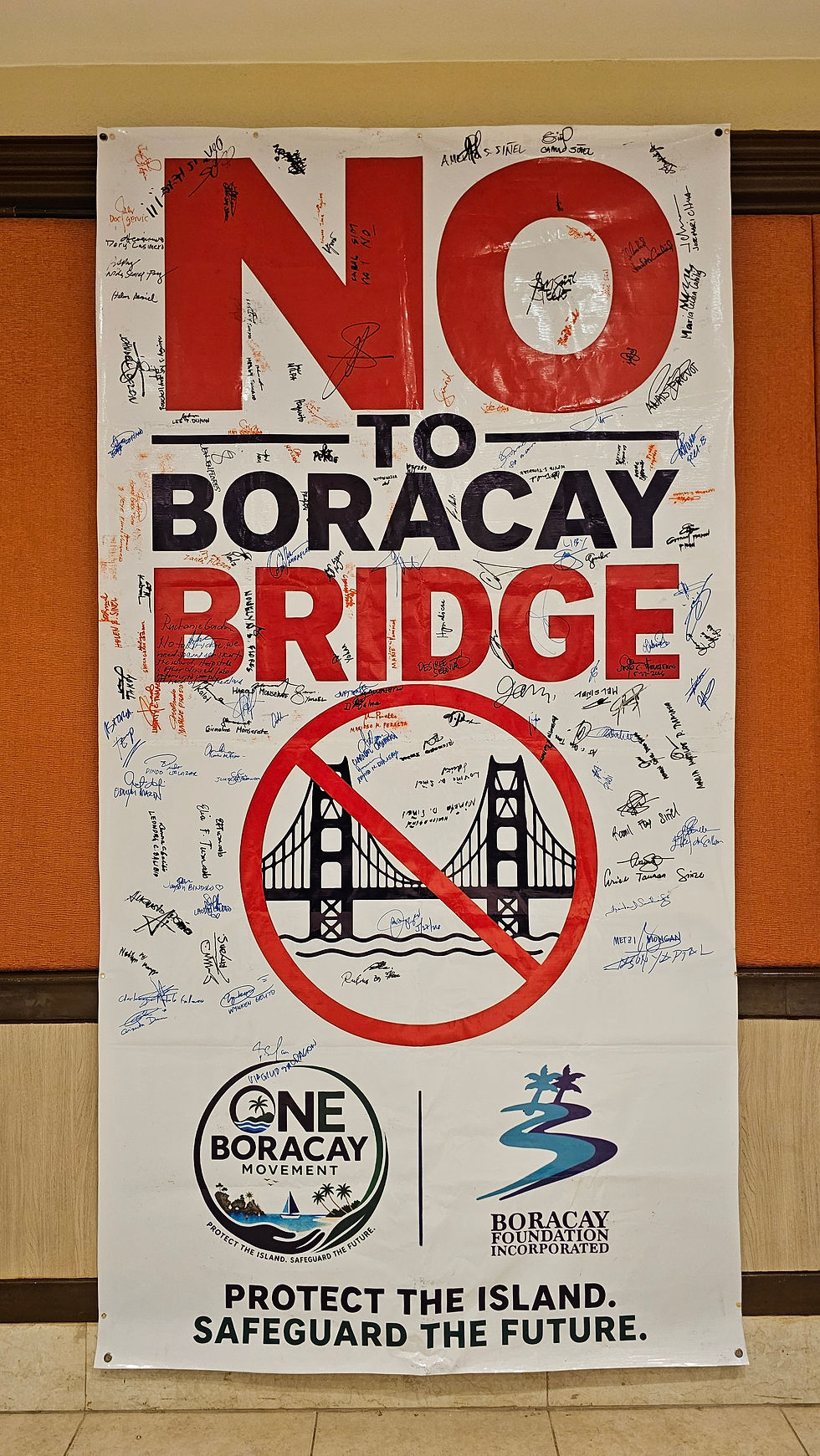
Community Pressure Paid Off
The statements made by Ang were widely interpreted by local officials and stakeholders as a withdrawal or suspension of the proposal, prompting celebration among sectors opposing the bridge.
Cong. Miraflores said they intentionally refrained from immediately announcing the development to national media because they wanted to first report directly to the Boracay community.
“He listened to your collective voices,” the congressman told stakeholders during the Boracay consultation meeting. “This is a product of the community working together.”
For many residents and stakeholders, the strong opposition mounted by the local community played a decisive role in forcing SMC to step back from actively pursuing the project.
Stakeholders React
Boracay Foundation Inc. (BFI) Chairman Dindo Salazar and Philippine Chamber of Commerce and Industry-Boracay (PCCI-Boracay) President Djila Winebrenner both welcomed the earlier announcement made by Aklan leaders.
“It is encouraging that these concerns reached the national level and were heard,” Winebrenner said. “We now look forward to official statements from Ramon Ang, SMC and the DPWH to provide clarity for all stakeholders.”
Media Frenzy
However, as stakeholders celebrated what many described as a “David versus Goliath” victory for the small island community, confusion emerged following a viral report claiming that Ramon Ang denied withdrawing from the project.
A GMA News report quoting Ang as allegedly saying “Not true” in response to claims that the project had been withdrawn.
The report quickly spread online and was reposted by numerous news organizations and social media pages, creating uncertainty. Although Ang was reportedly out of the country and unavailable for direct comment at the time, the conflicting narratives fueled public confusion regarding the project’s status.
Despite this, stakeholders have continued rallying behind the local leaders.
DPWH Notice of Award in Question
The proposed 2.54-kilometer bridge project was earlier awarded to San Miguel Holdings Corp. (SMHC) by DPWH through a public-private partnership (PPP) process, despite formal local opposition.
Questions surrounding the project’s approval process intensified after stakeholders learned that the Notice of Award was approved on March 25, 2026, reportedly on the same day Malacañang received formal opposition documents from the Boracay Foundation, Inc. (BFI).
Both the Sangguniang Bayan (SB) of Malay and the Aklan Sangguniang Panlalawigan (SP) had formally passed resolutions opposing the project, leaving the proposal without local government endorsements.
Critics questioned how the proposal advanced despite the absence of these endorsements, which are essential under both the PPP Code and provisions of the Local Government Code.
A multi-sectoral consultation followed the NOA’s issuance, bringing together local officials, stakeholders and business leaders. Stakeholders consolidated efforts through the revival of the One Boracay Movement, a broad coalition advocating sustainable development and the protection of Boracay’s environmental and economic future.

Manual signature campaigns and online petitions also emerged across the island, reflecting widespread grassroots opposition to the project.
Institutional Opposition Deepens
The controversy deepened after Sec. Vivencio Dizon stated that the project had already been discussed with the province, contradicting claims by local officials and stakeholders that no meaningful consultation had taken place before approval.
The controversy also triggered mounting institutional opposition from government bodies and sectoral organizations across Aklan.
The SP earlier passed resolutions opposing the bridge proposal and requesting complete project documents from the PPP Center, including feasibility studies and related agreements.
The League of Municipalities of the Philippines (LMP)-Aklan Chapter likewise expressed opposition to the project, with the province’s 17 mayors calling for a thorough Environmental Impact Assessment and meaningful consultation with affected sectors.
The Provincial Agriculture and Fishery Council (PAFC)-Aklan also passed a resolution opposing the project, citing possible impacts on fishermen, boat operators and marine ecosystems.
Youth organizations across the province have likewise issued statements opposing the project, arguing that development initiatives should not compromise environmental integrity and the welfare of future generations.
National attention toward the issue increased further after Party-list Rep. Leila de Lima filed House Resolution No. 1021 seeking a congressional inquiry into the bridge proposal and its approval process, including compliance with environmental review procedures.
The Departments of Tourism (DOT) and Environment and Natural Resources (DENR) had likewise earlier emphasized the importance of environmental studies and stakeholder consultations before the project could proceed.
Development vs. Sustainability
At the heart of the controversy is a broader debate over Boracay’s future.
The proposed bridge project has become one of the most polarizing development issues in Boracay in recent years, sparking debate over tourism, sustainability, accessibility and environmental protection, reminiscent of former President Duterte’s island rehabilitation closure in 2018.
Supporters argue that the bridge could improve logistics, emergency access and the movement of essential goods and services between Boracay and mainland Aklan.
Opponents argue that Boracay’s global appeal lies not in easier access, but in its environmental balance and unique visitor experience.
President Marcos himself highlighted the importance of preserving the traditional ferry experience during the July 14, 2025, groundbreaking of the new Passenger Terminal Building of the Boracay Airport in Caticlan.
“The ferry experience is very important and very much part of the Boracay experience,” the President said. “Pag sakay mo sa bangka, eto na, bakasyon na ito. That’s when the vacation really starts.” (Once you board the boat, that’s when the vacation really starts.)
SMC has emphasized that the proposed bridge is envisioned as a “controlled-access link” and is “not intended to open Boracay to unrestricted vehicle access.” The company also maintained that the bridge would complement, not replace, the existing boat transport system.
Salazar reiterated that the organization is not opposed to development, but believes any infrastructure project affecting Boracay must prioritize environmental sustainability and scientific review. "Our core advocacy has always been: preserve what we have, restore what we lost,” he added.
Stakeholders have also continued pushing for upgrades to Boracay’s aging jetty port system instead of pursuing a fixed bridge connection between the island and mainland Aklan.
Project in Limbo
SMC, meanwhile, said it will continue engaging stakeholders in good faith and work with government agencies, cooperatives and affected sectors to study mitigation measures, transition support and livelihood programs.
As of press time, neither SMC nor the DPWH has announced whether the project’s Notice of Award will remain active, be suspended, or undergo formal review.
Meanwhile, the ₱7.78-billion bridge proposal continues to face fierce local opposition rooted in environmental, livelihood and governance concerns.
Across Boracay and mainland Malay, “No to Boracay Bridge” stickers, shirts, tarps and online campaigns have become increasingly visible as opposition intensified.
For Boracay, the question is no longer simply whether the bridge project has been “withdrawn” or “not withdrawn,” but whether it can realistically proceed without the consent and trust of the very communities it seeks to enrich.


Comments